
Whether you're purchasing a home or monitoring your family's long-term exposure, you can be confident you're receiving accurate, reliable results.
C-NRPP Certified Radon Measurement Professional using Health Canada-approved methods.
A comprehensive report with your radon levels, results explained and next steps if levels are elevated.
Included with a 91-day radon test. Helps identify missing insulation and other issues.
A short term test, best for real-estate transactions or when you need quick results.
Health Canada's recommended method for your home's true average radon level. Best done during the heating season.

Radon is a naturally occurring radioactive gas created when uranium in soil and rock breaks down. You can't see, smell, or taste it, so the only way to know if it's in your home is to test.
Radon is present in the ground beneath every home. It enters through cracks, joints, sump pits, and gaps around pipes and wiring, and it can even move through the concrete basement slab.
In winter, heated indoor air rises and escapes, which pulls more air (and radon) up from the soil. This is called the stack effect, and it's why radon levels tend to be highest during the heating season.
Because radon levels vary from one home to the next, even between neighbours, you can't tell your level from the age of your house or what a neighbour found.
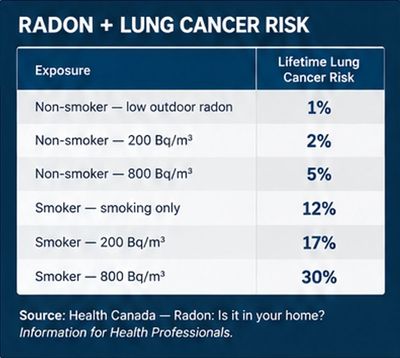
Long-term exposure to elevated radon is the second leading cause of lung cancer after smoking, and the leading cause among non-smokers. Testing is the only way to find out whether your family is being exposed.
Health Canada's radon guideline is 200 Bq/m³. If elevated levels are identified, we will explain the results, discuss mitigation options, and recommend a qualified C-NRPP Certified Radon Mitigation Professional.
Properly installed mitigation systems can significantly reduce radon levels and improve indoor air quality.

Contact us at (403) 550-3658 or fill our our contact form to schedule a test. We can book most tests same-week.
We use Airthings Corentium Pro, a professional continuous radon monitor approved by the C-NRPP for radon measurement in Canada for short-term testing. Alpha track test kits are utilized or long-term testing. When the test is complete, you send it back to us in a pre-paid envelope.
Your comprehensive report includes your radon results, an explanation of the findings, and recommendations if elevated levels are detected.

Ryan is the owner of Quantum Property Inspections, a Certified Master Inspector (CMI®) and a C-NRPP Certified Radon Measurement Professional. With extensive experience inspecting homes throughout Alberta, he specializes in identifying conditions that can affect a home's safety, performance and indoor environment. Ryan founded Quantum with a focus on thorough inspections, practical advice and helping homeowners make informed decisions about their properties.





Common questions about radon and radon testing.
Radon is a naturally occurring radioactive gas produced by the breakdown of uranium in soil and rock. It is colourless, odourless, and tasteless, making it impossible to detect without specialized testing.
Radon is present beneath every home and can enter throughout the year. During the heating season, the stack effect increases the pressure difference between the home and the soil beneath the basement slab, drawing more radon-bearing soil gas into the home. Although radon can enter through cracks, joints, sump pits, and service penetrations, it can also migrate through the concrete slab itself. Because every home is different, the only way to know your home's radon level is through testing.
Long-term testing provides the most accurate assessment of a home's average radon level.
Health Canada recommends testing for a minimum of 91 days, with the testing period occurring during the heating season whenever possible. Winter testing captures the period when the stack effect is typically greatest, providing the most representative assessment of a home's annual radon exposure.
A 48 hour test is handy when you require immediate results or when needed for real-estate transactions. While short-term testing offers a reliable snapshot of radon levels during the testing period, results can vary due to weather and seasonal conditions.
Yes. Any home can have elevated radon, including a brand-new one. Radon comes from the soil under the house, and it can enter through the concrete slab, cracks, sump pits, and gaps around pipes and wiring. New homes are also built to be very airtight, which can let radon build up instead of escaping. Your home's age and quality of construction don't predict its level, and the only way to know is to test.
Some new homes are built with a radon rough-in (a pipe through the slab that can be turned into a mitigation system later). That's a helpful head start, but it doesn't tell you what your radon level is, and it doesn't reduce radon until a system is actually installed. If you've bought a new build, we recommend a long-term test of 91+ days during the heating season for the most accurate result. If you're buying and need an answer quickly, a 48-hour test is available.
When you book our 91+ day test, Quantum Property Inspections performs a ventilation assessment, including the home's HRV or air exchanger (where applicable), and evaluates visible ventilation components that may influence indoor air quality.
We use cookies to analyze website traffic and optimize your website experience. By accepting our use of cookies, your data will be aggregated with all other user data.